Unloop: How I Designed a Music Discovery App That Breaks the Algorithmic Loop

UX/UI Design | Original Concept | 2 Weeks Tools: Figma, FigJam, Google Forms
Overview
Unloop is an original mobile app concept designed to solve one of the most overlooked problems in the music streaming industry: the algorithmic loop. Users who actively seek new music are consistently trapped in repetitive recommendation cycles, with no tools to break out. Unloop gives them control over their own discovery experience through transparent recommendations, cultural filters, and a live track identification feature built specifically for long DJ sets and concert recordings.
This case study documents the full design process: from problem identification and user research, through ideation and prototyping, to usability testing and iteration.
The Problem
Music streaming platforms are optimised for retention, not discovery. The more a user listens, the more the algorithm narrows its recommendations reinforcing familiar content rather than expanding taste. This creates what researchers call a “filter bubble”: an invisible boundary around the user’s listening habits that grows stronger over time.
Spotify’s own internal research confirmed this pattern. A 2020 study from Universidad Complutense de Madrid documented the effects of algorithmic curation on music taste diversity on Spotify. Industry publications, including Dazed Digital, have begun asking openly whether algorithms have killed music discovery altogether.
The business context is significant. Music streaming is a $38 billion global industry with over 600 million active users on Spotify alone. Yet despite this scale, a large segment of active listeners, those who genuinely seek new music, remain underserved by every major platform.
Research
Approach: Research was structured across three layers, designed to capture both quantitative patterns and qualitative depth.
Secondary Research: Six peer-reviewed academic sources were reviewed, covering algorithmic bias in music platforms, the neuroscience of music cognition, listener behavior patterns, and industry projections on the future of human-made music. Key sources included Spotify internal studies, NIH publications on music and cognition, and the ResearchGate publication on algorithmic curation effects on Spotify.
Survey Using the Lean Survey Canvas framework, an 18-question survey was designed to identify behavioral patterns and frustrations across a defined participant group. The canvas was used to clarify research goals, define who to recruit, and establish outreach strategy before a single question was written.
23 responses were collected from urban music listeners aged 18–34.
User Interviews: Six in-depth interviews were conducted, structured across five thematic blocks:
Discovery & Habits
Platform & Algorithm
Serendipity & Echo Chamber
Comprehension & Expression
Deficiency & Change
Recruitment criteria: everyday music listeners who actively seek new music but have no formal music training.
Key Survey Findings
Finding % of Respondents: "I can’t find a song I heard." 52.2% Always the same recommendations, 43.5%. I don’t understand why the algorithm shows me this. 34.8% "Difficulty switching between platforms" 26.1%
Key Insights
Insight 1: The Loop Is Real and Measurable. Every interview participant described a period of feeling trapped in repetitive recommendations. Platform-switching was the most common coping strategy, but the algorithm followed their taste profile across platforms, making it ineffective.
“The suggestions feel too familiar. It doesn’t help me discover enough new music.” — Maximilian, interview participant
Insight 2: Users Cannot Articulate Their Own Taste: 47% of survey respondents said they could not explain why they love a song. This gap between emotional experience and articulation represents a significant unmet need: users lack the tools to understand and communicate their own musical identity.
Insight 3: Algorithm Opacity Breeds Distrust: Over 50% of users do not understand how their platform decides what to recommend. When a recommendation does not match their taste, 90% ignore it and move on, a consistent passive signal of disengagement that platforms do not act on.
User Persona: Léa M. “The Active Explorer”
Age: 29, Occupation: Designer, Location: Urban, Platforms: Spotify, SoundCloud, YouTube
Biography: Léa is an urban creative professional who actively seeks new music but consistently relies on multiple platforms to find it. She is dissatisfied with algorithmic recommendations on every platform she uses yet has no viable alternative. She switches between Spotify, SoundCloud, and YouTube not out of preference but out of necessity.
Needs
Discover music that feels genuinely personal, not algorithmically assigned
Encounter artists she has never heard before
Reconnect with deep, immersive listening experiences
Pain Points
Every platform recommends the same trending artists she already knows
Switching platforms brings the same disappointment
No tool helps her understand or communicate her actual taste depth
“I feel like it limits what I end up listening to.”
User Journey Map
Léa’s journey mapped across five stages reveals a consistent emotional decline:
Stage Action Emotional State Platform Entry Opens app, navigates to feed Hopeful Seeking Discovery Reviews suggestions, encounters familiar content Disappointed Outside Exploration Switches platforms, searches manually Frustrated Algorithm Loop Returns to primary platform, same results Angry Disengagement Listens passively, stops actively seeking Disengaged
The final stage, emotional disengagement, represents the critical design opportunity. The How Might We questions generated from this map directly informed the feature architecture:
HMW give users control over how far outside their comfort zone they want to explore?
HMW turn “I’m stuck in a loop” into “I found something unexpected”?
HMW bring the discovery experience from YouTube and SoundCloud into one single platform?
Competitive Analysis
A perceptual map was constructed across two axes: passive to active discovery and mainstream to niche content.
Platform Position Key Gap: Spotify Semi-active / Mainstream Loop: inescapable, independent artists invisible YouTube The passive / mainstream video platform listening experience is secondary. Soundcloud semi-active / niche content exists, but the discovery experience is poor. Unloop Active / Niche This quadrant is unoccupied
No existing platform combines active user-controlled discovery with niche and independent content. This gap is Unloop’s strategic position.
Problem Statement
Music listeners who actively seek discovery need to find new music that truly resonates with them because existing platforms trap them in an algorithmic loop and fail to offer discovery as an experience.
Design Solution: Feature Prioritization MoSCoW Method
Must Have
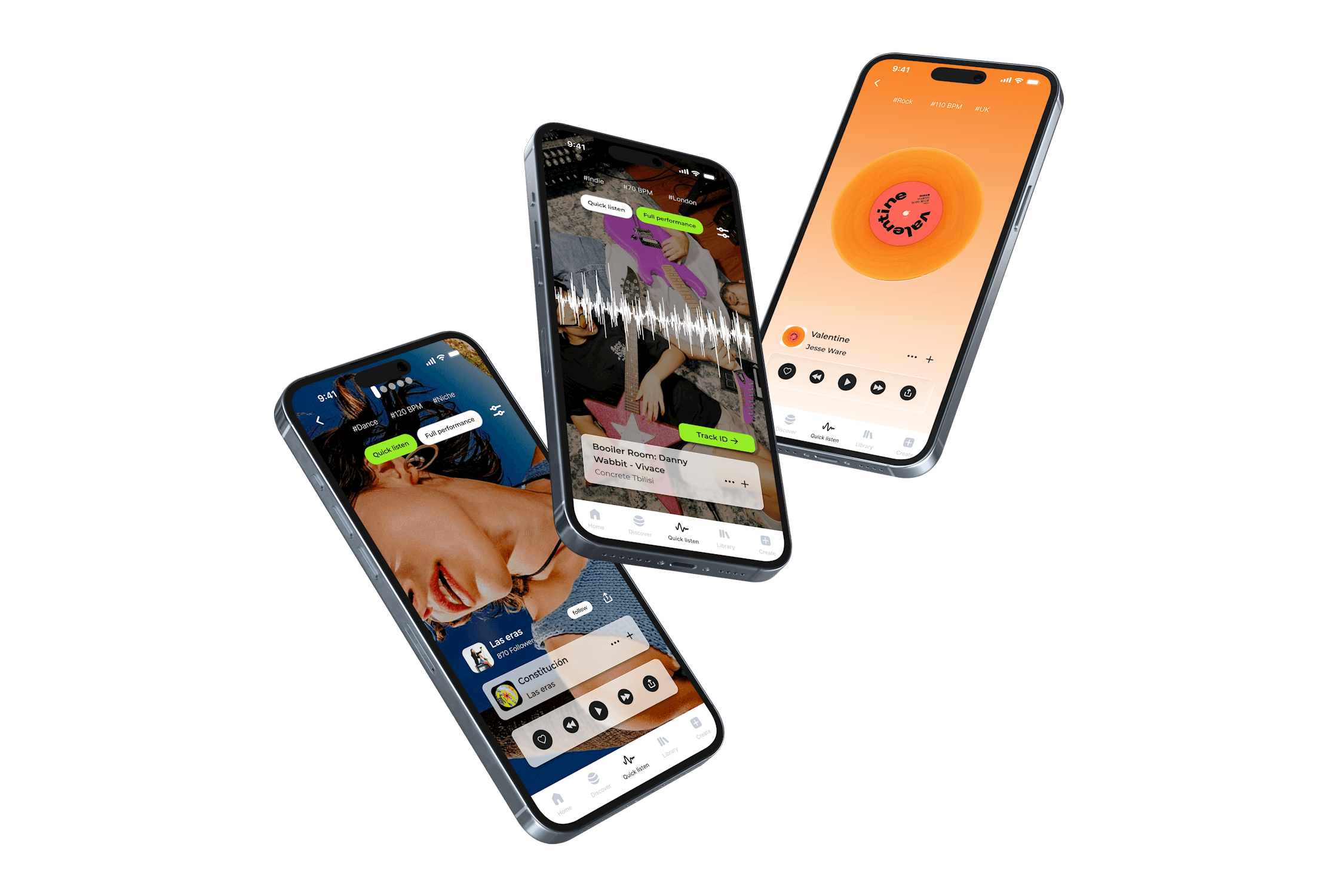
Quick Listen / Full Performance mode: 30-second previews or full DJ sets and concerts, with a transparent recommendation reason label on every suggestion
Track Spotlight (Live ID) automatic track identification during DJ mixes, with one-tap save to playlist
One-tap loop escape (Quick Dive)
Should Have
Familiarity Slider Mainstream to Underground, giving users direct control over discovery depth
City Vibe + Genre + BPM Filter cultural and musical context parameters
Editable Taste Profile users can view, edit, and reset what the algorithm has learned about them
Discovery History Screen
Could Have
Re-engagement surprise card
Human curator discovery feed
Won’t Have
Podcast / video integration shifts focus away from the core music discovery problem
Offline mode / downloads no direct relation to the discovery experience
Core Features
Quick Listen + Full Performance: The primary discovery interface. Users toggle between 30-second previews for rapid browsing and full DJ sets or concert recordings for immersive listening. Every track suggestion displays a transparent recommendation reason label, "Because you chose Dance, 120 BPM, Niche," directly addressing the algorithm opacity identified in research.
Track Spotlight / Track ID: While listening to a DJ mix or live performance, the platform automatically identifies the currently playing track and surfaces it as a floating card: artist name, track title, and venue. One tap saves it to a playlist. The mix continues without interruption. This feature was designed in direct response to a recurring interview finding: users consistently lose track of songs discovered in long sets, with no existing tool to solve it.
City Vibe + Genre + BPM Filter A real-time discovery filter accessible from within the listening screen. Users refine their discovery parameters genre, city scene, BPM range, and familiarity depth—without leaving the current track. City Vibe is based on a research finding that the most meaningful music discoveries are often place-based: a club in another city, a local radio station, a specific cultural scene.
Familiarity Slider: A single parameter from Mainstream to Underground. Users set how far outside their existing taste they want to explore. This is the direct design response to the echo chamber problem, giving users agency over their own discovery depth rather than surrendering it to the algorithm.
Information Architecture
The app is structured across five navigation sections:
Home Three discovery layers: New songs this week, Expand your taste (DJ mixes), Newborn Artist Radio (independent artists) Discover Exploration by familiarity scale, city, genre, BPM, new artists, and performances Quick Listen Core discovery mode: 30-second previews and full performances with Track ID Library Playlists, likes, saved finds, imported content, artist and genre collections Create Playlist creation, external import from Spotify and SoundCloud, Track Spotlight saves
User Flow Happy Path
Open App → Welcome Screen → Create Account → Set Genre, City & Artist Taste → Home Feed → Quick Dive → Quick Listen → [30-sec preview or Full Performance + Track ID] → Save to Playlist
Testing and Iteration
Round 1: Concept Testing (Mid-Fidelity)
Method: Moderated sessions, think-aloud protocol Participants: 4 active music listeners, 20s–30s, urban
Critical Finding 1: The mode toggle was invisible; 3 out of 4 participants did not notice the Quick Listen / Full Performance toggle in the grayscale wireframe. The core discovery mode distinction, one of the most differentiated features in Unloop, was functionally invisible.
Iteration: A high-contrast active state was introduced in the high-fi. Green = Quick Listen active. White = Full performance available.
Critical Finding 2 Familiarity Slider labels caused confusion. “New Listener” was interpreted as a skill level, not a discovery preference. Participants placed the slider at the center without understanding its purpose.
Iteration: Labels rewritten. Copy updated to: “From trending hits to hidden gems. Choose how deep you want to dig.” Endpoints changed to mainstream / underground.
Round 2: Usability Testing (Hi-Fidelity)
Method: Moderated task-based sessions, think-aloud protocol
Onboarding completion, mode toggle, Track ID identification and save, playlist save, Home Feed navigation
Task Completion Rate: 100%
Usability Testing Highlights
“The onboarding is strong. It actually asks the right questions.” “I love that I can set the filters myself. That’s what’s missing everywhere else.” “This is my favourite part, one tap and it’s in my playlist while the mix is still playing.” on Track ID
Onboarding: Join the Discovery
The onboarding flow was designed to be fast, personal, and purposeful. In three steps, the app builds an initial taste profile: the user selects their favorite genres, picks a city scene, and chooses artists they already love. Each step collects a different layer of preference, cultural context, musical energy, and personal identity.
The Familiarity Slider, introduced at the end of onboarding, asks one question no other platform has ever asked: how far outside your comfort zone do you want to go? From mainstream to underground, the user sets their own discovery depth from day one.
A step indicator was added after usability testing. Participants needed to know how many steps were ahead to feel confident moving forward. A small change with a measurable impact on completion confidence.
Next Steps
Phase 2 Editable Taste Profile · Discovery History Screen · Persistent mini-player on Home Feed · Quick Save from external platforms
Editable Taste Profile: Of all the should-have features, the Editable Taste Profile represents the deepest expression of Unloop’s core promise, giving users visibility into and control over what the algorithm has learned about them. It was not completed within the two-week timeline and remains the primary design priority for the next sprint.
Phase 3 Human Curator Discovery Feed · Re-engagement moment card · Social discovery layer
Conclusion
Unloop was designed from a single conviction: that music discovery should be an intentional experience, not a byproduct of an engagement algorithm.
Every feature in this product maps directly to a research finding. The Familiarity Slider came from users who described feeling trapped. The Track ID came from users who consistently lost songs in DJ mixes. The City Vibe filter came from users whose most meaningful discoveries were always tied to a place.
Research-driven design is not a methodology. It is a commitment to solving the right problem and building something users actually need.
date published
Jun 5, 2026
reading time
9 min